What to See at Topkapı Palace: The Highlights That Matter
There is far more inside Topkapı than anyone sees in one visit. This is the short list of what actually rewards the walk, and where each highlight sits, so you spend your hours on the rooms that matter.
Written with Mehmet Demir, Istanbul Topkapi Palace ticket specialist
Short answer
The essential stops at Topkapı Palace are the Harem, the Imperial Treasury with its famous dagger and diamond, the Sacred Relics chamber, the İznik-tiled pavilions, the Imperial Council chamber, and the fourth-courtyard terrace over the Bosphorus. The Harem and Treasury are the two that most define a visit. Everything else you fit around them depending on how much time you have.
Half of Topkapı is corridors, kitchens and courtyards you will glance at once and forget. The other half holds objects and rooms people fly across the world to stand in front of. The trick to a good visit is knowing which is which before you go, so you are not still deciding what to prioritise when your feet are already tired and the palace is filling up.
What are the must-see highlights at Topkapı Palace?
The five stops almost no one should skip are the Harem, the Imperial Treasury, the Sacred Relics chamber, the İznik-tiled pavilions of the inner courts, and the fourth-courtyard terrace over the Bosphorus. The Harem and the Treasury carry the most weight; the rest you slot in around them according to your time and interest. Everything below builds on those five.
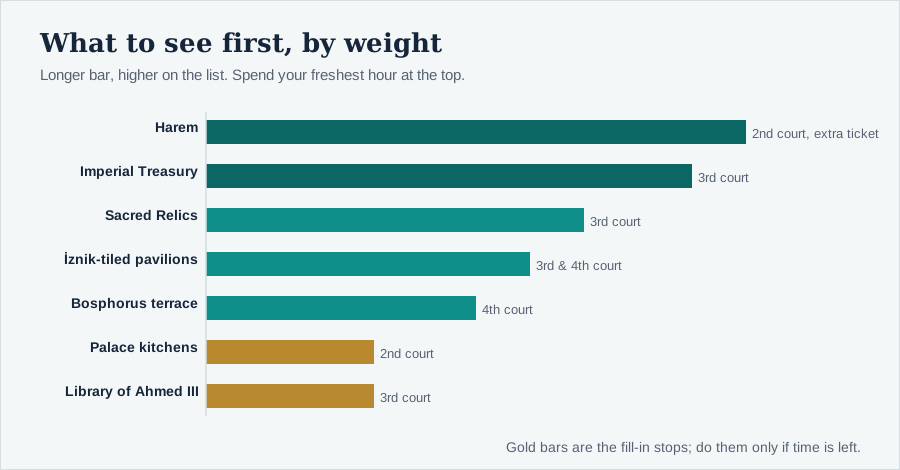
Ranked by how much most visitors regret missing them, the picture looks like this:
Highlight
Where it sits
Why it makes the list
The Harem
Off the second courtyard
The palace's most atmospheric section, a separate ticket
Imperial Treasury
Third courtyard
The famous dagger, the large diamond, the thrones
Sacred Relics chamber
Third courtyard
Islam's revered relics, a quiet respectful room
İznik-tiled pavilions
Third and fourth courts
The finest ceramic art in the palace
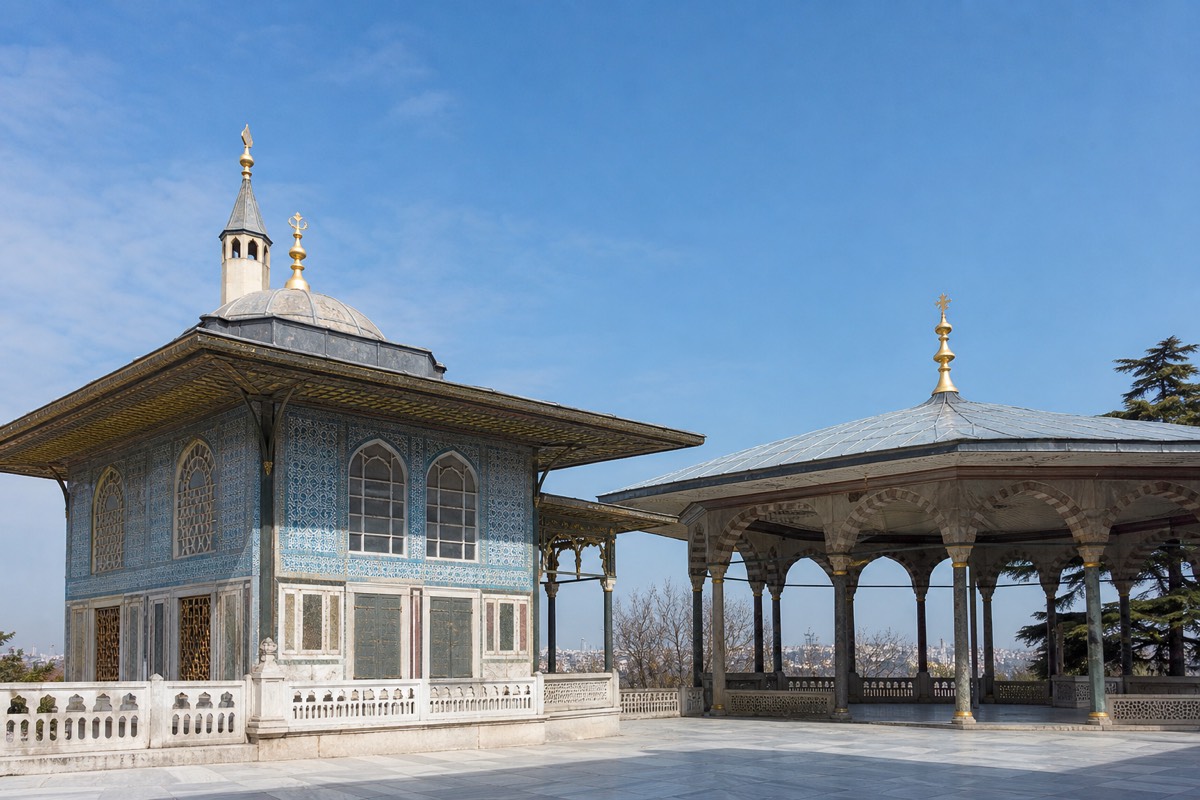
Fourth-courtyard terrace
Fourth courtyard
Baghdad Kiosk and the best Bosphorus view
Top rated on GetYourGuide
Best for the Harem plus Ottoman history explained by a live guide
Topkapi Palace & Harem Guided Tour with Ticket
4.8across 1,928 GetYourGuide reviews, run by Walks In Europe
Skip-the-line entry to Topkapi Palace and the private Harem, both included in one ticket
Licensed guide walks you through the Palace and Harem, then you keep exploring on your own afterwards
Headsets to hear the guide, and free cancellation up to 24 hours before
Live price on GetYourGuide shown for your date, option and currency at booking
Rating and reviews are Walks In Europe's current GetYourGuide figures; check the listing for today's price. Security screening at the palace gate applies to everyone.
Which highlights are worth paying extra or planning around?
The Harem is the one paid add-on almost everyone says is worth it, since it needs its own ticket on top of the palace, and the Treasury is the section most worth timing for an early, uncrowded look. Those two decisions, whether to add the Harem and when to hit the Treasury, shape the whole visit more than any other choice you make at the gate.
The Harem is a warren rather than a single grand room, corridors of tiled chambers, courtyards and the sultan's private quarters, and our full walkthrough of what the Harem actually contains explains why the extra ticket is the one most people are glad they bought. The Treasury, by contrast, is compact and high-value, which is exactly why it bottlenecks; the rundown of its headline cases and the photography ban is worth reading before you go so you know what you are looking at in the few minutes inside. If you are still weighing whether the whole palace earns its place in a packed Istanbul trip, our honest take on whether Topkapı is worth it lays out the case both ways.
The two decisions above split cleanly by what they cost you:
Beyond the big five, the İznik tilework, the palace kitchens, the Imperial Council chamber, the Library of Ahmed III and Hagia Irene reward anyone with time to spare. These are the stops that separate a rushed hour from a full morning, and they are where the palace's craftsmanship and quiet corners live.
Spend your first, freshest hour on the top of the list; let the lower stops fill the time you have left.
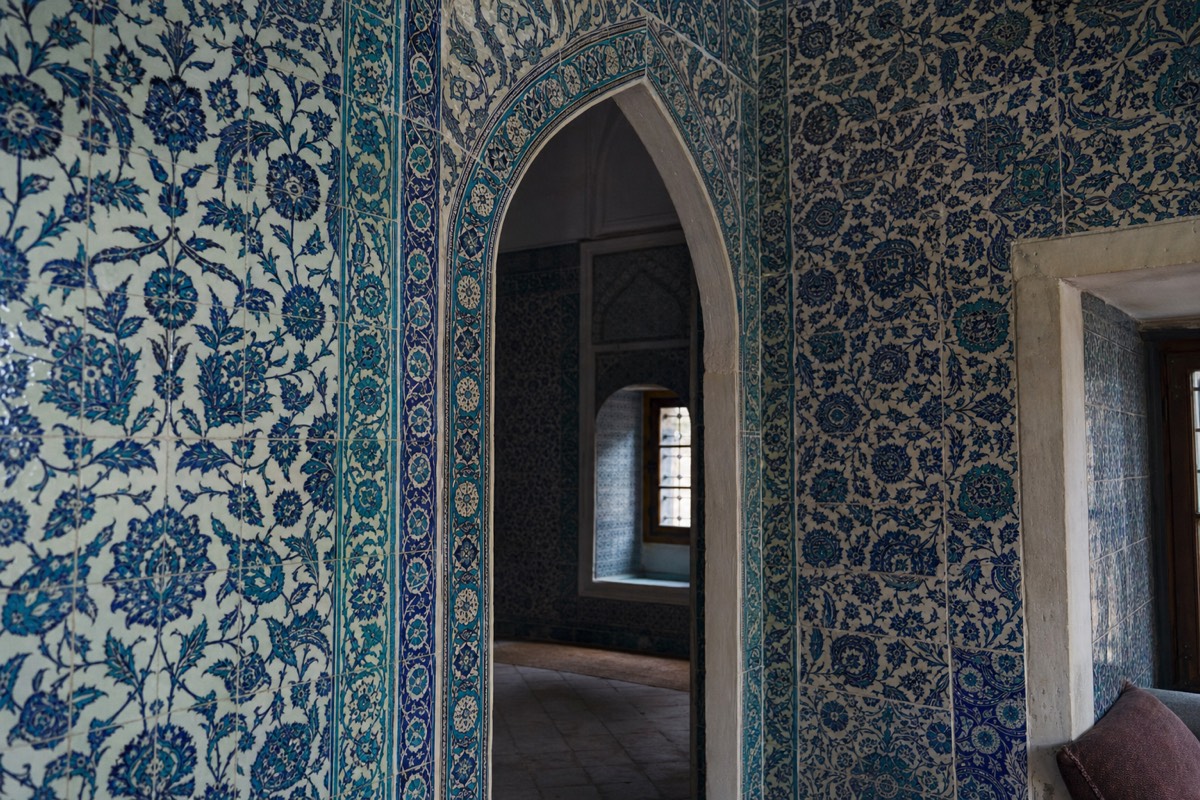
The tilework deserves a special mention. The blue, turquoise and coral-red panels lining the Harem and the Baghdad Kiosk are among the finest surviving examples of Ottoman ceramics, and our piece on the İznik tiles and where the best panels are points you to the walls worth slowing down for. In the Treasury, the object that draws the longest queue has a film-star past, told in full in the story of the Topkapı Dagger. And in that free first courtyard stands the Byzantine church of Hagia Irene, older than the palace itself and often overlooked because it needs a separate admission.
Here is roughly how the highlights break down by the time they ask of you:
Time you can spare
What to prioritise
What to skip
Under 2 hours
Treasury, Sacred Relics, terrace
The Harem, the kitchens
2 to 3 hours
Add the Harem and the İznik pavilions
Hagia Irene interior
Half a day
Add the kitchens, library, Hagia Irene
Nothing major
How you spend those hours is its own question, and our guide to how long the palace really takes gives the honest ranges rather than the optimistic ones. The single biggest lever on your experience is not the route but the timing: an early arrival lets you stand in front of the Treasury cases and walk the Harem corridors before the day's crowds converge on the same small rooms.
How do the highlights map to the courtyards?
Almost every highlight sits in the third and fourth courtyards, with the Harem branching off the second, so once you clear the ticket gate the good stuff comes in a tight, walkable cluster. That clustering is why a front-to-back route works so well, and why our full map of the courtyards and gates is worth a look before you arrive.
The official record backs the layout: the National Palaces page for Topkapı treats the complex as a graded progression through its courts, and the official museum listing is the place to confirm which rooms are open, since sections rotate through restoration and the odd pavilion closes without notice. A guided old-city walk can string Topkapı together with the surrounding monuments as a separate booking if you want the wider peninsula in one go, and you can see what that route covers here.
Pick your five, arrive early, and let the smaller stops fill whatever time is left. That is the whole strategy, and it beats trying to see everything and enjoying none of it.
How long should you allow for each highlight?
Allow about two hours for the palace on its own and closer to three or four with the Harem added, then split that budget across the sections below. The Harem is the single biggest block at roughly 45 to 60 minutes; the Treasury and the Sacred Relics chamber take 15 to 30 each; the courtyards, kitchens and terrace absorb whatever is left. Treat these as planning allowances, not a timetable the palace enforces.
The Harem has quietly grown in the last two years, which is why it now asks more of your clock than older guidebooks suggest. The Concubines' Court, its bath and the Kuşhane kitchen opened in 2024. The Has Oda privy chambers came back in May 2025 after roughly a decade of restoration. And in 2026 a section closed since the 1660s reopened furnished with around 750 historical objects, adding about twenty minutes to the route on its own. If your ticket includes the Harem, lean toward the top of every range in the table.
The Treasury works the other way. It is compact and packed with the palace's most valuable objects, so a small room fills fast, and part of your allowance goes on simply waiting for a clear view of a case. An early start is the only real fix. Before any of this, security at the Imperial Gate is its own line, airport-style screening that cannot be skipped even with a skip-the-ticket-line ticket, so give it time rather than being caught out by it.
The sensible way to spend the allowances is front to back, in the order the courtyards come. Clear the gate, take the second courtyard and the Harem branch, then work through the third and fourth courtyards where most of the highlights cluster. Keep one eye on the closing time: the palace generally runs to around 18:00, the box office shuts earlier, and last admission is roughly thirty minutes before close, so the final rooms need to be on your list well before then.
A guided ticket and a self-guided one spend these allowances in different shapes. With a licensed guide the Harem and the Treasury tend to move faster, because someone is steering you to the cases that matter and past the ones that do not, so the minutes you save land on the courtyards and the terrace. Self-guided with an audio app you set your own pace, which is freeing if you like to linger and slower if you stop to read everything. Neither is wrong. They just fill the same two-to-four-hour window differently, and it helps to know which kind of visitor you are before you pick a ticket.
Section
Typical time to allow
Worth knowing
Security and entry at the Imperial Gate
15 to 30 min
Airport-style screening, cannot be skipped
The Harem
45 to 60 min
Longer now that new rooms have reopened; a separate ticket
Imperial Treasury
20 to 30 min
Compact and high-value, so it bottlenecks by late morning
Sacred Relics chamber
15 to 20 min
A quiet, respectful room; no photography
İznik-tiled pavilions and Baghdad Kiosk
15 to 20 min
The fourth-court terrace sits right here
Palace kitchens
15 to 20 min
A long gallery, easy to walk at pace
Imperial Council and Tower of Justice
10 to 15 min
Off the second courtyard
Library of Ahmed III
10 min
The third courtyard's calm centrepiece
Hagia Irene
20 to 30 min
A separate admission in the first courtyard
One caveat sits over the whole table: sections rotate through restoration. On recent listings the Outer Treasury, parts of the Matbah-ı Âmire kitchens and the Petition Chamber have been flagged as temporarily closed, so an allowance can drop to zero on the day if a room is shut. The official museum listing is the place to confirm what is open before you commit an hour to it.
What should you see if you only have an hour?
With a single hour, skip the Harem and head straight for the Imperial Treasury, the Sacred Relics chamber and the fourth-courtyard terrace, in that order, then spend any minutes left on the İznik tiles nearest the terrace. An hour cannot cover the palace, but it can cover its densest, most memorable rooms. The Harem needs its own ticket and its own block of time, so it is the honest thing to drop first.
An hour really does mean an hour of looking, not of queuing, so the order matters. Clear security, walk briskly through the second courtyard without stopping, and spend your freshest time in the Treasury while the cases are still readable. The Sacred Relics chamber is a short walk on and asks only that you slow down and put the camera away. Finish on the terrace, where the Baghdad Kiosk and the water view are the one place photography is welcome and the one memory most people keep.
The single-hour visit is more common than it sounds. Plenty of people reach Topkapı with a cruise stop, a tight connection or a Sultanahmet day already stacked with Hagia Sophia and the Blue Mosque, and they arrive knowing the palace deserves more than they can give it. If that is you, resist the urge to sample a little of everything. A shallow lap of the whole complex leaves almost nothing behind, while three rooms seen properly stay with you. Skip the Harem cleanly rather than half-doing it, and come back another day for the section that needs its own ticket and its own hour.
Minutes
Where to be
What you are seeing
0 to 15
Clear security, walk through to the third courtyard
The gates and second courtyard in passing
15 to 35
Imperial Treasury
The famous dagger, the large diamond, the thrones
35 to 50
Sacred Relics chamber
Islam's revered relics in a hushed room
50 to 60
Fourth-courtyard terrace and nearest tiles
The Baghdad Kiosk, İznik panels and the Bosphorus view
Who you are changes the shortlist more than how much time you carry. A history reader and an architecture lover walk the same palace and remember different rooms, so it helps to know your own bias before the gate rather than at it. The grid below is where I start most people who ask me to cut their list down.
If you are
Prioritise
Comfortably skip
A history reader
Treasury, Sacred Relics, Harem
The kitchens gallery
An art or architecture lover
İznik pavilions, Baghdad Kiosk, Harem tilework
The Hagia Irene interior
Travelling with children
Courtyards, kitchens, the terrace view
The Sacred Relics queue
Very short on time
Treasury, terrace, one Harem loop
Library, Hagia Irene
For families, our guide to Topkapı with kids goes further on what holds young attention, and if the hour question is really a whole-visit question, how long the palace takes gives the honest ranges rather than the optimistic ones.
The highlights I tell visitors to skip
I have specialised in Topkapı tickets since 2012, I grew up in this city, and by my own count I have pointed more than a thousand visitors toward the right ticket and the right route. The question I answer most is not what to see. It is what to leave out, because the people who try to see everything are the ones who leave tired and underwhelmed. So here is where I tell people to save their energy.
Do not queue to photograph a single Treasury case. Photography is not allowed inside anyway, so the wait buys you nothing you can keep, and the terrace outside gives you the shot the Treasury never will. Do not walk the full length of the kitchens unless the ceramics genuinely interest you; it is a long, repetitive gallery, and those twenty minutes are better spent on a second, slower loop of the Harem now that its new rooms are open. And do not try to read every label. The palace is too large to absorb that way, and the visitors who pick five rooms and see them properly always describe a better day than the ones who speed-read forty.
What visitors over-invest in
Why it tends to disappoint
Where the time is better spent
Queuing to photograph a Treasury case
Photography is banned inside, so nothing is gained
Longer on the terrace, where photos are allowed
The full length of the kitchens gallery
Long and repetitive for most tastes
A second, slower Harem loop
Reading every label in every room
The palace is too big to absorb this way
Fewer rooms, seen properly and unhurried
There is a softer mistake too, and it is one of pace rather than choice. Visitors treat the courtyards as corridors to hurry through on the way to the next indoor room, when the courtyards are part of the point: shaded, open, and the one place you can rest your feet and your eyes without a queue forming behind you. Give them a few unhurried minutes and the indoor rooms land better for it.
The one thing I never tell anyone to skip is an early arrival. A weekday start near opening, ideally in spring or autumn, does more for a visit than any route I could draw, because it puts you in front of the Treasury cases and inside the Harem corridors before the day's summer crowds converge on the same small rooms.
Frequently asked questions
What is the number one thing to see at Topkapı Palace?
The Harem is the single most rewarding section for most visitors, followed closely by the Imperial Treasury. If you only have time for one paid extra beyond the palace ticket, the Harem is it.
Can you see Topkapı Palace in one visit?
You can see the highlights in one visit, not every room. Prioritise the Harem, the Treasury, the Sacred Relics chamber, the İznik pavilions and the terrace, and let the kitchens, library and Hagia Irene fill whatever time is left.
Is the Harem worth seeing at Topkapı?
For most people, yes. It needs its own ticket on top of the palace admission, but its tiled corridors and private chambers are the palace's most atmospheric section and the part visitors least regret paying for.
What is in the Imperial Treasury?
The Ottoman dynasty's most precious objects, including the emerald-set Topkapı Dagger, a very large diamond and the imperial thrones. Photography is typically not allowed inside, so put the camera away and look.
Where are the best tiles at Topkapı Palace?
The finest İznik tile panels line the Harem and the Baghdad Kiosk in the fourth courtyard. The blue, turquoise and coral-red floral tilework there is among the best surviving Ottoman ceramic art.
See the highlights in the right order
The featured guided ticket covers the Harem, the Treasury and the standout rooms under one licensed guide. Live price and dates on the official GetYourGuide listing.