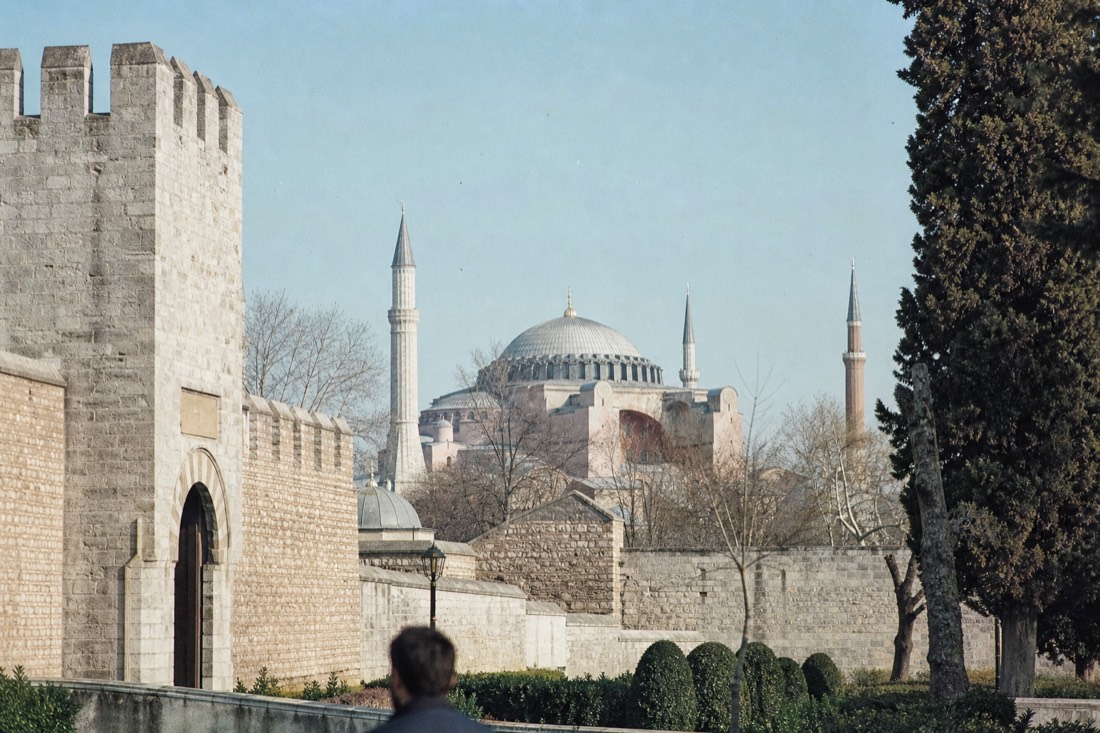
These two sit next to each other and get compared constantly, but they answer different questions. Here is how they differ, and why most visitors should simply do both.
Written with Mehmet Demir, Istanbul Topkapi Palace ticket specialist
Short answer
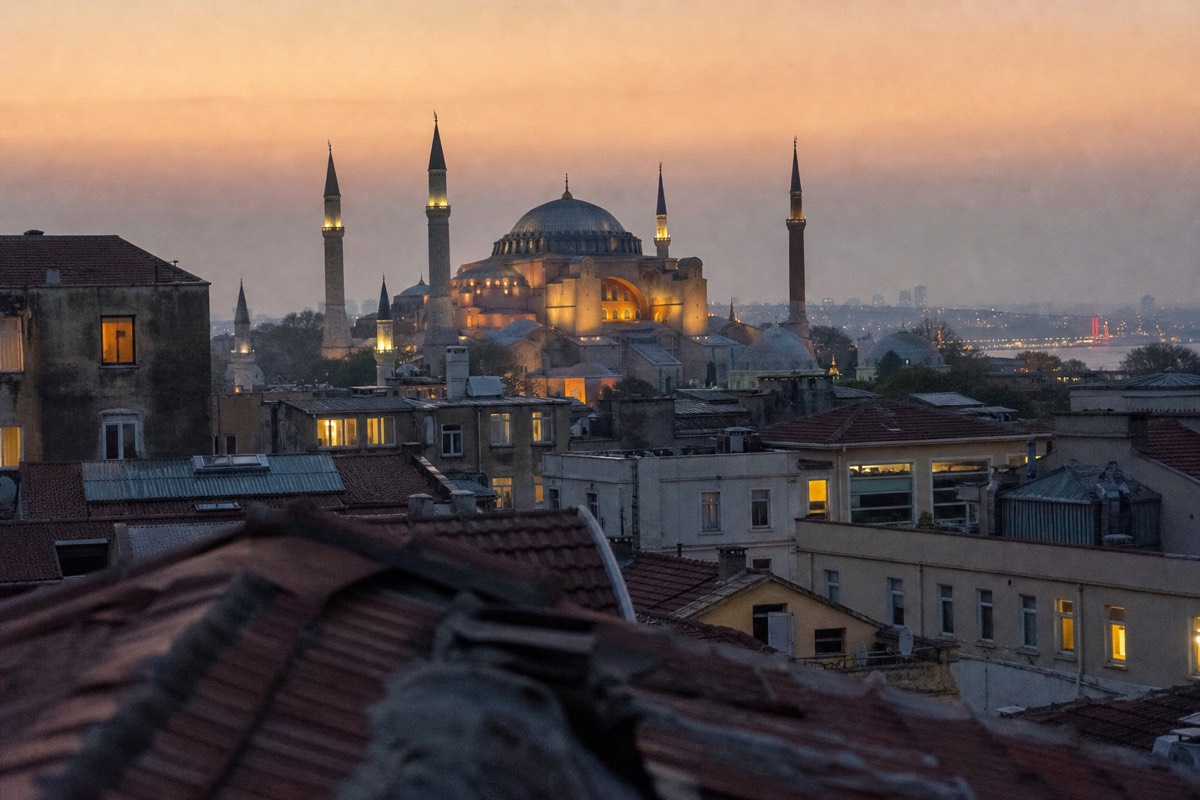
Topkapı Palace and Hagia Sophia are neighbours in Sultanahmet, a few minutes' walk apart, and they are different kinds of visit rather than rivals. Hagia Sophia is a single, awe-inspiring domed monument you can see fairly quickly; it functions as a working mosque, so it has prayer times and a dress code. Topkapı is a large palace complex you explore over two to four hours. Most first-time visitors do both in one day, seeing Hagia Sophia first and giving Topkapı the longer block of time, ideally starting at the palace early.
This is not really an either-or, though it gets framed that way constantly. Topkapı and Hagia Sophia stand a few minutes' walk apart, and they are so different in kind that choosing between them is like choosing between a cathedral and a castle. The useful question is not which one, but in what order, and how much time each deserves. On that, I have a clear recommendation.
To thread both into a wider plan, one day in Sultanahmet sequences the whole historic peninsula.
Topkapı Palace or Hagia Sophia: what is the difference?
Hagia Sophia is one monumental domed building you experience as a single space; Topkapı is a sprawling palace complex you walk through over hours. One is a knockout interior seen fairly quickly, the other a layered site of courtyards, the Treasury and the Harem that rewards a long, slow visit.
They also serve different roles today. Hagia Sophia functions as a working mosque, which shapes how you visit it: there are prayer times to work around and a dress code to respect, in line with mosque etiquette. Topkapı is a museum complex with ticketed sections, security screening at the gate, and no official dress code. So beyond the history, the practical experience of each is quite distinct, which is exactly why they complement rather than replace each other.
Rating and reviews are Walks In Europe's current GetYourGuide figures; check the listing for today's price. Security screening at the palace gate applies to everyone.
Do you have to choose between them?
No, and most visitors should not. They sit side by side in Sultanahmet, so seeing both in one day is easy and is what I recommend to nearly everyone. Skipping one to save time usually means missing something you travelled a long way to see.
The two are close enough that the walk between them takes only a few minutes, past the same cluster that includes the Blue Mosque. Because Hagia Sophia is a quicker visit and Topkapı is the longer one, they fit together neatly: you can give the palace the two-to-four-hour block it needs and still fold in Hagia Sophia the same day. Unless your Istanbul time is extremely tight, doing both is the obvious call.
Neither is a niche pick, either. Topkapı logged 4,683,250 visitors in 2024, well up on the year before, and Hagia Sophia has run at roughly fifty thousand people a day since it reopened as a mosque. You will not have either place to yourself, which makes order and timing matter more, not less.
Site
Recent visitor numbers
Period
Topkapı Palace
4,683,250
2024, up from 3,474,760 in 2023
Hagia Sophia
About 25 million
July 2020 to July 2024, six to seven million a year
Hagia Sophia
More than 40 million
The five years since its 2020 reconversion as a mosque
Start early at Topkapı, since the palace needs the most time and its inner rooms fill by late morning, then see Hagia Sophia afterward, checking its prayer times before you go. That order protects the visit that is hardest to rush.
Here is the plan I give visitors, starting with the T1 tram to Sultanahmet or Gülhane. Arrive at Topkapı near the 09:00 opening with a skip-the-line ticket, clear security, and take the Harem and the Treasury while they are still quiet. Give the palace two to four hours depending on whether you include the Harem. Then walk the few minutes to Hagia Sophia, timing your entry around its prayer times, since as a working mosque it closes to visitors during those; foreign tourists also pay a 25 euro fee for the visitor gallery, introduced in January 2024. Add the Blue Mosque, also a working mosque with prayer times, if you have the afternoon. Comfortable shoes matter across the whole day, because the ground in Sultanahmet and inside the palace is uneven and spread out. If you would rather have both mosques guided, a small-group Blue Mosque and Hagia Sophia tour covers them together with the history filled in, a separate booking from your palace ticket; you can check the small-group tour here.
Time
Stop
Why then
Near 09:00
Topkapı: security, then Harem and Treasury
Inner rooms are quiet before late morning
Late morning
Topkapı courtyards and terraces
The indoor sections crowd first; outside stays pleasant
Early afternoon
Walk a few minutes to Hagia Sophia
Time your entry between prayer times
Rest of afternoon
Blue Mosque, if energy allows
Same cluster on foot, also prayer-time bound
Which should you prioritise if time is tight?
If you truly can see only one, choose by taste: Topkapı for depth, history and a half-day of exploring; Hagia Sophia for a single, breathtaking space you can take in quickly. There is no universal winner, because they scratch different itches.
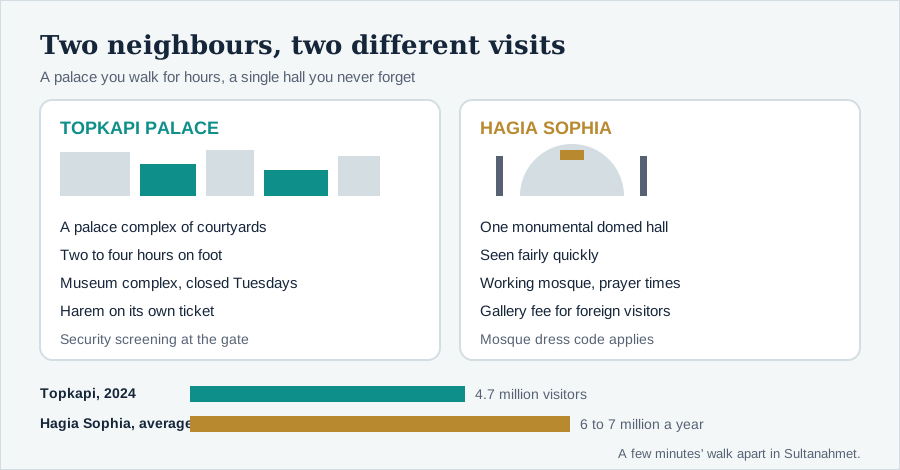
A palace you walk for hours beside a single hall you never forget: different scales, one neighbourhood.
Pick Topkapı if you want to walk through the Ottoman story, see the Treasury and the Harem, and have half a day to give it. Pick Hagia Sophia if your time is measured in minutes rather than hours and you want one overwhelming monument. We make the longer case for the palace in is Topkapı worth it, but I will say again that this trade-off rarely needs making, because the two are neighbours, and the day that includes both is better than either alone. The featured Topkapı ticket bundles skip-the-line entry, the Harem and a guide, which keeps the palace half of that day efficient so you have time left for Hagia Sophia; if you would rather self-pace the palace, weigh it against the audio option in guided vs audio-guide.
Which is quicker to get into, and how do the entry rules differ?
Hagia Sophia is usually the faster building to enter, since its visitor gallery is a single ticketed space, while Topkapı puts everyone through airport-style security at the Imperial Gate and then into separate ticketed sections. The catch is that Hagia Sophia closes to visitors during prayer times, so its speed depends entirely on when you arrive. The two bottleneck in different ways, and knowing which is which decides your morning.
Topkapı's slow point is the gate. Security screening at the Imperial Gate cannot be skipped, not even with a skip-the-ticket-line ticket, because the line you skip is the box-office line, not the scanner. Large bags, backpacks and suitcases are refused or heavily scrutinised, and there is no cloakroom or left-luggage on site, so anything you cannot carry comfortably becomes a problem before you reach the first courtyard. Inside, photography is not allowed in the exhibition halls, the Sacred Relics chamber or, typically, the Imperial Treasury, and flash is banned throughout.
Hagia Sophia's slow point is the clock. As a working mosque it closes to visitors during the daily prayers, so an arrival that lands on a prayer time means a wait outside no matter how short the queue looks. It also carries a mosque dress code, shoulders and knees covered and a head covering for women, which Topkapı does not impose. Since January 2024 foreign visitors pay a set fee for the upper gallery, shown at the entrance, while worshippers enter free through a separate door.
The table below sets the practical mechanics side by side, the details you feel on the day rather than the high-level differences.
Practical point
Topkapı Palace
Hagia Sophia
Main bottleneck
Airport-style security at the Imperial Gate
Prayer-time closures for visitors
What a skip-line ticket does
Skips only the ticket line, never the security scan
Timed around prayers, not a paid skip
Bags
Large bags refused; no cloakroom on site
Bags screened; a cover-up may be needed
Photography inside
Banned in halls, Sacred Relics and Treasury; no flash
Allowed in the gallery, respect worshippers
Dress
No official dress code
Mosque dress code applies
Getting there
T1 tram to Sultanahmet or Gülhane
Same cluster, a few minutes on foot
These mechanics change what you pack and when you show up more than most people expect. Because Topkapı refuses large bags and has nowhere to store them, the day you plan to see both is not the day to carry a suitcase between hotels; travel light or leave the luggage before you start. And because the security scan at the gate is a fixed cost you cannot buy your way past, a skip-the-ticket-line ticket saves you the box-office wait but not the scanner, so treat the two lines as separate when you budget the morning. For Hagia Sophia, the equivalent planning move is to look up the day's prayer times before you leave, since those, not the queue, decide when the doors are open to you.
When are Topkapı and Hagia Sophia busiest?
Both peak from late morning through mid-afternoon, especially on weekends and across the summer, so the quiet window is the same for each: a weekday arrival near opening, ideally in spring or autumn. Topkapı's inner rooms clog first, while Hagia Sophia's crowding tracks its prayer schedule as much as the season. Aim to be inside one of them before the tour groups land.
Topkapı feels full long before it looks full, because the rooms that matter are small. The Treasury and the Harem take a large share of the day's visitors through a handful of tight spaces, so they crowd well ahead of the open courtyards. Hagia Sophia crowds differently: it is one vast hall, so the pressure is less about small rooms and more about when the doors reopen after each prayer. Neither empties in high season, which is why the honest goal is the first hour, not an empty room.
Weekends and public holidays stack local visitors on top of the tourist flow at both places, so if your dates are flexible, a mid-week visit is the easiest crowd win there is. The shoulder months do the same job through the calendar rather than the week: April, May, September and October give you gentler weather and thinner queues at the same time, which is the combination that makes a two-landmark day feel unhurried instead of forced.
Time of day
Topkapı
Hagia Sophia
Opening to mid-morning
Quietest; the inner rooms are still readable
Quiet outside prayer times
Late morning to early afternoon
Busiest; Treasury and Harem clog
Busy, with prayer-time pauses
Late afternoon
Eases as groups leave; mind last admission
Eases, still prayer-time bound
Season swings the whole thing further than time of day does. Spring and autumn are the comfortable windows at both sites, summer is peak everywhere, and winter trades crowds for shorter daylight and seasonal hours. Topkapı closes on Tuesdays year round, so a Tuesday leaves you with Hagia Sophia and the mosques but not the palace, which is a common trap for a two-day trip planned around the wrong day.
Season
What to expect
Verdict
Spring (Apr to May)
Mild weather, lighter weekday mornings
Best all-round window
Summer (Jun to Aug)
Peak numbers at both, hot and full
Go at opening or not at all
Autumn (Sep to Oct)
Comfortable weather, thinning crowds
Nearly as good as spring
Winter (Nov to Mar)
Fewest people, shorter hours, cooler
Quiet; check the seasonal times first
The order mistake I fix most often
I have specialised in Topkapı tickets since 2012, I have lived in Istanbul my whole life, and I have talked more than a thousand visitors through how to fit the palace into a packed Sultanahmet day. The plan I correct most is the tidy-sounding one: Hagia Sophia first because it is quicker, then Topkapı after lunch. It feels efficient and it is usually wrong.
Topkapı is the visit that cannot be rushed and the one whose best rooms fill by late morning, so saving it for the afternoon means walking its most crowded corridors at its busiest hour. I flip the order for almost everyone. Take Topkapı at opening, clear security while the Treasury and Harem are still quiet, then walk the few minutes to Hagia Sophia afterward and time your entry between its prayers. The building that runs on a clock is the flexible one; the building that runs on crowds is not, so you protect the palace and bend around the mosque, never the reverse.
There is a reason the wrong order is so tempting, and it is worth naming. Hagia Sophia looks like the quick win, the box you tick first so you feel ahead of schedule. But a tick early in the day is a poor trade for the palace's best hour, and I have watched too many people spend that hour shuffling through a packed Treasury when they could have had it nearly to themselves at nine. Momentum is not the goal. The quiet rooms are.
The other thing I tell people is to hold time in reserve rather than budget to the minute. If your day shrinks, drop the Harem before you drop either site, because losing the Harem still leaves you both landmarks, while dropping a whole site loses something you travelled a long way for. The grid below is how I split limited time between the two.
If your day is
Give Topkapı
Give Hagia Sophia
The trade
A full day
3 to 4 hours, Harem included
45 to 60 min plus a prayer buffer
See both properly
A half day
About 2 hours, palace highlights
About 45 min
Drop the Harem, keep both sites
A few hours
About 90 min, Treasury and terrace
About 30 min
Skip the depth, keep the neighbours
When someone still wants Hagia Sophia first, usually because a group or a fixed booking makes it simplest, I do not fight it. I just move their Topkapı slot as early as the morning allows and warn them plainly that the inner rooms will be busier by the time they arrive, so they should head straight for the Treasury and the Harem and save the courtyards for last. The order is a preference with a good reason behind it, not a law, and a slightly crowded palace you actually reached beats a perfect plan you never finished.
None of these splits is a rule, only a starting point. Check Topkapı's day and hours and Hagia Sophia's prayer times before you lock anything in, because the one thing that reliably wrecks a well-planned Sultanahmet day is arriving on a Tuesday or during a prayer and finding the door you wanted closed.
Frequently asked questions
Should I visit Topkapı Palace or Hagia Sophia?
Both, if you can. They sit a few minutes apart in Sultanahmet and are different experiences: Hagia Sophia is a single monumental space seen quickly, Topkapı is a large palace complex explored over hours. Most first-time visitors do both in one day.
Can you visit Topkapı and Hagia Sophia in one day?
Yes, easily. They are neighbours. Start early at Topkapı, since it needs two to four hours and fills by late morning, then see Hagia Sophia afterward, checking its prayer times first.
Which is better, Topkapı or Hagia Sophia?
Neither is universally better; they are different. Choose Topkapı for depth, history and a half-day of exploring, and Hagia Sophia for one breathtaking interior seen quickly. Doing both avoids the choice.
Is there a dress code for Hagia Sophia and Topkapı?
Hagia Sophia is a working mosque, so it has a dress code and prayer times to respect. Topkapı has no official dress code, though modest clothing is sensible near its sacred areas.
How far is Topkapı Palace from Hagia Sophia?
Just a few minutes' walk. The two stand side by side in Sultanahmet, along with the Blue Mosque, so the whole cluster is easy to cover on foot.
Book your Topkapı entry
Skip the ticket line at the palace. Live price and dates on the official GetYourGuide listing.