The Spoonmaker's Diamond: The Treasury's Most Famous Stone
The Spoonmaker's Diamond is the star of Topkapi's Imperial Treasury, and its story runs from a fisherman's rubbish heap to the Ottoman court. Here is the established history and the legends, and what to know before you visit.
 By Mehmet Demir, Istanbul Topkapi Palace ticket specialist
There is a single object in the Imperial Treasury that most people walk in to see, whether they admit it or not. The Spoonmaker's Diamond, the Kaşıkçı Elması in Turkish, sits in its own case and stops nearly everyone who passes. It is a large teardrop-shaped stone ringed by a double row of smaller brilliants, and under the lights it does exactly what a famous diamond is supposed to do.
What it is
The stone is usually described as an 86-carat pear-shaped diamond, set in a border of dozens of smaller diamonds, which puts it among the largest diamonds held in any museum collection in the world.
It has belonged to the Ottoman treasury for centuries and remains one of the defining pieces of the collection at Topkapi. The rooms around it hold plenty that deserves a slow lap of its own, and our Imperial Treasury highlights guide picks out what not to walk past.
| Detail | The stone |
|---|---|
| Turkish name | Kaşıkçı Elması |
| Usual description | 86 carats, pear shaped |
| Setting | A double row of smaller brilliant-cut diamonds |
| Home | The Imperial Treasury at Topkapi Palace |
| Display | Its own case, low light, usually a small crowd |
Beyond the raw numbers, part of the draw is simply that it is here, in the treasury of the dynasty that once ruled from these rooms, rather than sold off or scattered. You are looking at it more or less where the Ottoman court kept it. The simplest way to see it in context is the Topkapi Palace & Harem Guided Tour, which walks the palace with a licensed guide and leaves you free time for the treasury cases afterward; check live availability & prices on GetYourGuide.
The legend that gave it its name
The diamond is named for a market trade: in the story, a fisherman who had no idea what he had found handed the stone to a spoonmaker for next to nothing.
As the tale goes, the fisherman spotted a bright stone among the rubbish near Eğrikapı, on the old land walls of Istanbul. He traded it away in the market, and depending on who tells the story he got a few wooden spoons or a small handful of coins for it. Only later did anyone understand what had changed hands.
I always flag this as a legend rather than documented history, because that is what it is. It is the kind of story a great object attracts, and whether or not it happened, it gave the diamond the name it still carries.
The other origin story
Historians take a second account more seriously, one that links the stone to a diamond out of India that passed through European hands in the eighteenth century.

In that version the stone is connected to a French officer named Pigot, and to a chain of owners that eventually brought it into the Ottoman treasury. The details differ from telling to telling, and the two theories have never been fully reconciled.
| The spoonmaker legend | The Pigot account | |
|---|---|---|
| How the stone surfaces | Found in a rubbish heap near Eğrikapı | Mined in India, sold on in Europe |
| Key figure | A fisherman and a market spoonmaker | A French officer named Pigot |
| Paper trail | None, folk memory only | A documented chain of owners |
| Standing today | Legend, and the source of the name | The account historians weight more heavily |
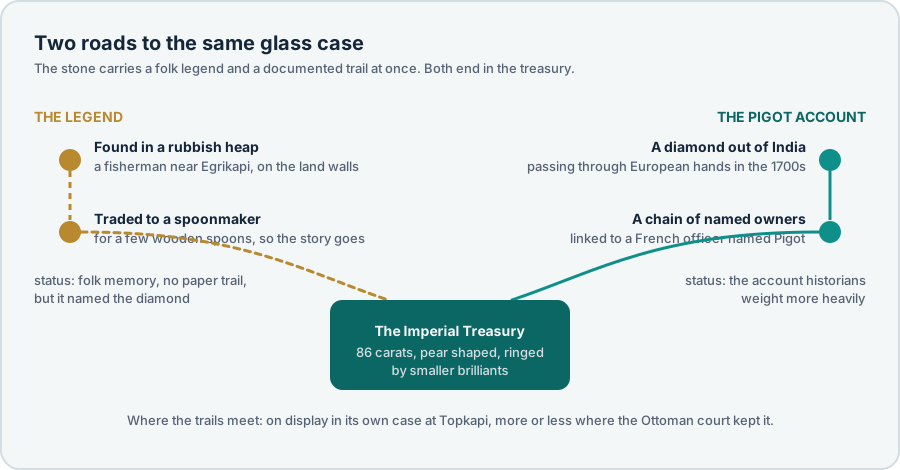
What matters for a visitor is that both stories survive side by side. One is folk legend, one is a documented trail, and the museum stone carries both reputations at once. Standing in front of it, you are looking at an object whose exact history is still argued over, which is part of why it holds attention the way it does.
A note on photography
Photography is restricted inside the treasury rooms, and you should not expect to take pictures of the diamond.
The rule protects the objects and keeps the crowded rooms moving, and it is enforced. Come prepared to look rather than shoot, and give yourself a minute at the case instead of fighting for an angle you are not allowed to use anyway.
That constraint is honestly not a bad thing. The treasury is dense, the lighting is low, and the objects reward attention. You will remember the diamond better for having actually looked at it.
Seeing it on a visit
The Imperial Treasury is part of the main palace at Topkapi, and since January 2024 the standard palace ticket has covered the treasury rooms, so any full ticket routes you toward the diamond.

A few planning notes make the visit smoother. The palace is closed on Tuesdays, so do not build your trip around that day. The treasury sits deeper in the complex, in the inner courts, so leave yourself the two to three hours the palace really needs, and our timing guide breaks that budget down court by court. Add more if the Harem is on your list, since it is a separate ticketed section that only the guided option includes. In summer the palace has also been running night openings that take in the Treasury exhibition, a program that started in 2024 and grew in 2026. With the diamond seen, the Basilica Cistern a few minutes away is the Old City's other unmissable sight and an easy add to the same day, booked separately from Topkapi; you can check availability here.
| Plan item | Detail |
|---|---|
| Closed day | Tuesday |
| Treasury access | Included in the standard palace ticket since January 2024 |
| Photography | Restricted in the treasury rooms |
| Time to allow | 2 to 3 hours for the palace, more with the Harem |
| Where it sits | The inner courts, deep in the complex |
Book your entry ahead so you skip the long ticket line at the gate, and know that the security screening at the Imperial Gate is separate and cannot be skipped by anyone. Current hours sit on the official National Palaces page, and they shift with the season. If you are weighing the guided ticket against the cheaper audio one, our guided versus audio comparison settles it in a couple of minutes. The Sacred Relics chamber shares the same inner court as the treasury, so pair the two. Then come and see the stone the market almost missed.